
A letter sent by the Sir Dorabji Tata Trust to Venu Srinivasan, Tata Trusts vice-chairman and nominee director on Tata Sons, a day before the Tata Sons board meeting on September 17, is at the centre of deliberations.

Tata Sons, now debt-free, has asked the RBI to drop its 'upper-layer NBFC' tag and allow it to stay private.

'It is unfortunate that the Chairman of Tata Sons, a Company renowned for setting high standards of corporate governance, is contending reappointment on such an untenable interpretation of the Articles'.
Seven of them posted losses, led by Air India, with their combined net loss widening to Rs 31,823 crore in FY26 from Rs 17,553 crore a year earlier and Rs 1,555 crore in FY20.

Listing, according to Noel Tata, will fundamentally change how the company and the group have been working over the past 150 years.

N Chandrasekaran's letter of not seeking a third term was written to Tata Sons directors (including to Noel Tata as a nominee director) and, therefore, Tata Trusts did not have a locus standi on accepting or rejecting that letter.

J R D Tata, chairman of the Tata group from 1938 to 1991, said that whenever he had to make a difficult decision, he would ask himself, what will be good for India, and what will be good for the Tatas. If he had a doubt, he would decide in favour of India. In the long run, it would turn out well for the Tatas too, he said, points out Arun Maira.

Tata Sons chairman N Chandrasekaran has announced an investigation into allegations of sexual harassment and forced religious conversion at TCS's Nashik branch, calling the claims 'gravely concerning'.
'...but should prepare for listing unless a court grants effective interim relief.'

Noel Tata, chairman of Tata Trusts, has presented a proposal for the Shapoorji Pallonji (SP) group to sell its 18.37 per cent stake in Tata Sons for approximately 25,000 crore, aiming to address the SP group's liquidity needs without a public listing of Tata Sons.
At a valuation of around Rs 10 trillion, Tata Sons would rank among India's 10 largest listed companies and could qualify for inclusion in key indices such as the Nifty 50, Sensex and the Nifty 100.
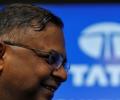
The Tata Sons board has voted to reappoint N Chandrasekaran as chairman for a third five-year term, a decision influenced by the Reserve Bank of India's rejection of the company's application to surrender its NBFC registration, which revives the prospect of a stock market listing.

'You can't have a runaway board that takes decisions against the active disagreement of the 66 per cent shareholder.'
'You can't have a runaway board that takes decisions against the active disagreement of the 66 per cent shareholder.'

The Uttar Pradesh Cabinet has approved the expansion of the proposed temple museum in Ayodhya, contracting Tata Sons to develop and operate the project on a 52-acre site.

N Chandrasekaran, chairman of Tata Sons, announced he would not seek reappointment when his term ends in February 2027, following a series of departures by senior figures closely associated with former chairman Ratan Tata, including Vijay Singh and Mehli Mistry, amid a deepening power struggle and governance dispute within the Tata Group.

Tata Sons has the balance sheet to support them, for now.

'whom he believes in ... or whom he has faith in. But we don't know whether that person will be competent or not. This will lead to a lot of uncertainty in the minds of investors and shareholders of the Tata group companies.'

Corporate leaders' half-life has shrunk over the past few decades. That is the Tata experience as well. Over 144 years till 2012, Tata Sons had just five chairmen. However, in the 15 years till 2027, the same group will see three, points out R Gopalakrishnan.

Seven listed Tata companies together own 12.1 per cent in Tata Sons with a combined book value worth around Rs 30,700 crore.

'Members of Indian family businesses have considered it their birthright to work there and responsibility to take care of it.'
SP Group chairman Shapoorji Pallonji Mistry on Friday reiterated calls for public listing of Tata Sons to bring transparency, amid infighting among trustees of Tata Trusts which controls a 66 per cent stake in the holding company of the salt-to-software conglomerate. Shapoorji Pallonji family is the single largest minority shareholder with about 18.37 per cent in Tata Sons.

N Chandrasekaran's decision not to seek reappointment when his term as chairman of Tata Sons ends in February 2027 signals a significant shift in leadership amidst an ongoing power struggle and governance disputes within the Tata Group.
Tata Group stocks experienced a significant decline, with TCS falling nearly 6 per cent, after Tata Sons Chairman N Chandrasekaran announced he would not seek reappointment when his current term concludes on February 20, 2027.

'... that work is done. The task is to reallocate what has been built, with the courage of a founder and the discipline of an owner.'

Tata Sons Chairman N Chandrasekaran views the group's investment in semiconductors not as a short-term financial play, but as a critical long-term commitment to India's growth and self-reliance in a sector vital for domestic consumption and global supply chains.

N Chandrasekaran not only faces muted financial performance from the group's listed companies, but also mounting losses at Tata Sons' unlisted subsidiaries, many of which have been set up by him in the last decade.

Shapoorji Pallonji Mistry's statement will be watched closely against the backdrop of the listing battle as well as the Tata leadership contest, with veto votes being cast over the reappointment of N Chandrasekaran as chairman of Tata Sons for a third term.

The authorities have said that it is not permissible to examine and review in 2026 the decision taken by the trustees in 1988 regarding the existence of necessity for transfer of shares.
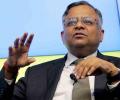
Tata Sons Ltd, the holding company of the $150 billion Tata group, may be forced to infuse fresh capital into its loss-making telecom arm, Tata Teleservices Ltd (TTSL). This is because TTSL has to pay Rs 19,256 crore adjusted gross revenue (AGR) along with other dues to the central government by March 2026.

'On a plain reading of Article 121, it can be said that the chairman's casting vote can be invoked in either of these cases.'
Tata Sons' dividend from Tata group companies for last financial year is expected to show a decline of 3.5 per cent to Rs 36,514 crore from Rs 37,832 crore a year earlier. This should be the first year-on-year decline in Tata Sons' dividend in the last nine years. The holding company had last reported a decline in FY16, when its proceeds had gone down 42.5 per cent to Rs 6,898 crore from Rs 11,993 crore a year earlier.

Indications are that the Tata Sons stand on listing of the company may come up for a discussion even if it's not part of the agenda

Indian benchmark equity indices, Sensex and Nifty, extended their decline for a second consecutive day, primarily due to elevated crude oil prices and selling pressure on Tata Group stocks following Tata Sons Chairman N Chandrasekaran's announcement that he will not seek reappointment.

The much-awaited board meeting of Tata Sons did not discuss listing of the holding company or a third term for Chairman N Chandrasekaran.
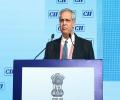
'The quality of a leader should be such that even if the leader is not there, the institution carries on.'

While the latest trigger for him stepping down could be the uncertainty around his renewal as a director at the AGM, which is otherwise a routine matter, Chandra may have been contemplating quitting for some time now because of the overall turbulence with the principal shareholder on the leadership issue.

'Chandrasekaran wanted a five-year extension, but the Tata Group has a policy of 65 years as the retirement age for its executive chairman.'

Tata Sons chairman N Chandrasekaran has issued a statement explaining his decision not to seek an extension beyond his current tenure, which ends on February 20, 2027, citing a lack of unanimous board support for his reappointment.

Tata Steel more than doubled its Indian capacity through acquisitions and expansion, strengthening cash generation as it pursued a costly restructuring of its European operations.
